RGV Museum
______________________________________________________________________________________________________

City Departments

  OPEN:
Tuesday thru Saturday
10:00 a.m. - 4:00 p.m. & Sunday: 1:00 - 4:00 p.m.
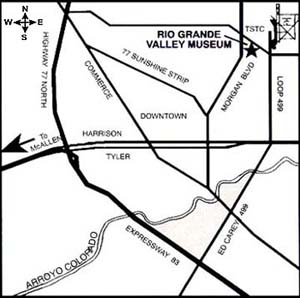
Boxwood at Raintree across from Texas State Technical College
Harlingen, Texas  78550
(956) 430-8500    FAX (956) 430-8502

Tours only at:
10:00am, 1:00 pm and 3:00 pm


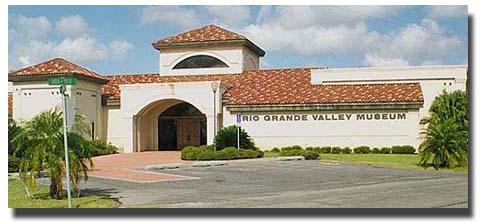
RIO GRANDE VALLEY MUSEUM
UPCOMING EXHIBITS 2005


   Texas Independence!  The Alamo!  The Republic of Texas!    A time turned to legend through song and cinema, is detailed with facsimile documents, flags and portraits.  After seeing the exhibit, watch the film that recreates the personalities and decisions that  ended in independence.  A monument to Texas describes the bronze sculpture commissioned during 1986, the Texas Sesquicentennial (150 years of school).  The massive work represents all those who contributed to the unique heart, the soul and the heritage of Texas.

   Railroads truly opened up the Valley for commerce and development.  When Lon Hill traveled to the Valley about 1900, he recognized the good soil and potential for irrigation.  Agriculture would be the future of the Valley if produce could be shipped.  Early railroad history, from schedule cards to lanterns, spikes and photographs, document the growth of the Valley and the train.

    Personal items from Lon Hill and the era help add to the rustic authenticity of these days gone by.  Memorabilia from old photographs to clothing worn by members of the family elaborately decorate the Hill Home, erected on the grounds of the museum.

   For a city that didn't exist 100 years ago, Harlingen has grown up fast.   Since 1905, the name changed several times in early years, from Lon C. Hill Town to Six-Shooter Junction to Harlingen, a Holland city with canals of its own.  See Historic Harlingen when the city was only a couple of roads, crossing Downtown near the railroad.  This room-sized model is complete with buildings, a train and inhabitants.   Additional photos from the earliest days to aerial shots of the city detail the growth.


    Tour guides help create the Old West through stories in the actual refurbished dwellings.  You never know what you might see in these old buildings!
  
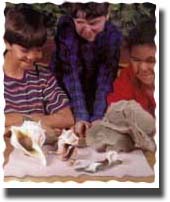
   Natural history is on display, too.  An extensive exhibit of the Gulf Coast shells is present, as are displays of gems, rocks and minerals, featuring those found in Texas.  Additionally, examples of native vegetation, types of citrus and varieties of palms growing on the grounds are labeled for easy identification.   Local bird species are frequently present.
  
   The new Museum offers visitors many images of history and nature through temporary exhibits on topics as varied as archaeology or agriculture, custom cowboys boots or Texas wildflowers, Gulf fish or folkart from Mexico.  Changing several times a year, they often have programs and craft classes classes, too.  In addition, video facilities offer the chance to view a growing number of tapes:  see the complete list available at the Museum or ask your tour guide.
     
   
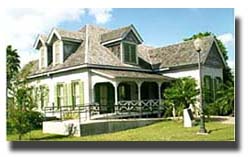
The Hill House is the restored home of Lon Hill, given credit for seeing the agricultural potential of the land, founding Harlingen, and instrumental for bringing the railroads and land development to the Valley in the early 1900's.  The Harlingen Hospital, the first in the city, dates from the 1920's and depicts early health care in the Valley, complete with physician's and dentist's offices, surgical suite, pharmacy and more.  All were moved to the Museum site from their original locations, restored and furnished.

     Experience the Rio Grande Valley....From earliest Native American inhabitants of the Valley who lived by hunting and gathering to Pineda's first Spanish voyage of exploration.  From Escandon's Mexican colonization and the   subsequent land grants to Texas Independence, the agricultural land developers of the early 1900's to the maquilladoras of the present, people have been drawn to the Rio Grande Valley.  To all it has to offered a land full of potential and abundant resources.  The Rio Grande Valley Museum exists to demonstrate the contributions of the Native American groups, the countries of Spain, France, Mexico, the Republic of Texas, The Confederacy and The United States, countless individuals and the natural history which have contributed to create the heritage of Texas.
   

    The Valley has long been the flood plain of the wandering Rio Grande River.  The Pineda Stone, found near the mouth of the River, is part of the Museum's collection and commemorates the landing of the earliest Spanish explorer.  Begin to understand these
conquistafores who sailed from Spain to the unknown, all for "God, gold and glory".

     The River became history's highway, offering communication, transportation to the interior and settlement on its banks.  Early land grants formed the base for the grant cattle ranches' fame.  Branding irons and other ranching equipment are on permanent exhibit in the Historical Museum.
   During your visit, tour the historic structures at the Museum.  The Paso Real Stagecoach Inn, originally on the banks of the Arroyo Colorado, gives a view of life about 1870 when travel was by horse and wagon and it took three days to journey 80 miles.
   
   The Historical Museum has many displays that  chronicle early Valley life and Texas history.  See exhibits on ranching and railroads, two elements of early commerce. View a new exhibit on the Republic of Texas, 1836-1845, with facsimile documents, portraits and flags.  Quilts from earlier times in the Valley are on permanent exhibit, some made here, others brought from homes far away.  Inspect some of our historic collection of quilts and garments or examine our early portraits and photos of the life and times of the area.
   
    See a real "wanted poster" of Pancho Villa, dating from the years of cross0border skirmishes.  This tale of the Bandit Years is told with actual artifacts and photos.  Look at maps of Harlingen or the entire Valley, some dating from the Colonial period when this was part of Mexico.


     Historical evidence from the last battle of the Civil War, Palmito Ranch, is on display.  This battle, also known as Palmito Hill, was fought May 12, 1865.  Although more than a month after the surrender (April 9), word had not yet reached this most-southern area that the war was over.  Victory in this battle, at least, belonged to the South.  Other Civil War era objects are on display, including objects from the abandoned town of Bagdad.
   
   During your visit, join the Museum Association to support the continuing growth, exhibits and community outreach for all our citizens and visitors.

Experience the history and come back often. 
We look forward to your visit !!!


Musemp2.jpg (29148 bytes)


Rio Grande Valley Museum           MUSENEWS      Rental Information     top of page


Home

© 2005, City of Harlingen