
CHAPTER 1
INTRODUCTION
"If we could first know where we are, and whither we are tending, we could better judge what to do and how to do it." - ABRAHAM LINCOLN
Harlingen's Vision 2020 Comprehensive Plan is the general plan for land use and development for the City of Harlingen, Texas. The comprehensive plan is the City's guide for government officials and citizens in making decisions about land use and development. The Vision 2020 plan:
* Addresses most aspects of community and urban lifestyle;
* Identifies issues that affect quality of life for residents;
* Defines goals and objectives for seizing opportunities and meeting existing and future needs; and,
* Recommends specific proposals for programs and actions that should be implemented by the City.
Vision 2020 is a comprehensive plan in the manner that it identifies the myriad of factors related to future community growth, analyzes the relationships between these factors, proposes what needs to be done about them, and recommends goals, objectives, policies, and actions for using the City's resources in the most efficient and effective ways.
Make No small plans...for they have no magic to stir men's souls."- DANIEL BURNHAM
Vision 2020 presents the future view of citizens and leaders of Harlingen -- of what they want the community to be, now and extending 20 years into the future. The plan translates this future vision into goals, objectives, policies, and actions, which are designed to guide the community's leaders and citizens in making decisions that will help to achieve the vision in the future.
Harlingen's Vision
The theme for the Vision 2020 plan is expressed by the City of Harlingen's vision statement:
Harlingen's Vision: |
The vision statement was originally developed and adopted by the Mayor and City Commission. It has been modified in the first major revision to reflect the change in leadership and focus of city activities since the adoption of the original plan. It remains a clear and provocative statement of the community's strengths, ambitions, and expectations.
Harlingen's Vision conveys at once the community's self image of its past, present and future. Its people and their strong values and rich cultural heritage, are the established assets upon which Harlingen is building its future. Harlingen today possesses many exciting opportunities: it is a city with opportunity for a high quality of life, ... a city that is liveable for all its citizens.
The vision also recognizes that Harlingen is uniquely situated geographically, economically, and developmentally for the community to enhance its current and future position as an international leader in these fields. In industry, Harlingen serves the entire Valley including both the U.S. and Mexico. Its local government and education systems are considered leaders among South Texas communities, providing essential stability, cooperative opportunities and infrastructure for future growth, and teaching the intellectual development and technical skills needed for personal and economic growth. For both air and ground transportation modes, Harlingen is the transportation gateway to the Valley for travel and commerce between the U.S. and Mexico, and to other Valley communities including South Padre Island. Medicine and health care and other industries catering to the Winter Texas population are a central element of Harlingen's community services, employment opportunity, and economic growth.
Harlingen's Vision expresses a collective vision of what its citizens and leaders want the city to be now and in the future. The Vision incorporates the community's values in terms of its liveability, its social character and special sense of "home town," its urban quality of life, its environmental quality, its economic opportunity, and its integration of new development into the existing city fabric.
Citizens Committed to the Betterment of their Community
Dozens of citizens dedicated hours of their time to the update of the Comprehensive Plan chapter by chapter. Some chapters, such as Land Use, required extensive citizen involvement while some chapters, such as Water and Wastewater, were more factual and simply afforded the public opportunity to comment on information available. Every effort was made to involve any and all citizens who had an interest in the Plan update. Letters were sent to individuals and agencies encouraging participation in areas of interest. Flyers were placed in dozens of public bulletin boards at local grocery stores, apartment complexes, laundry mats, churches, doctor's offices, restaurants, educational institutions and even distributed door to door.
"Consensus can be described as cooperative problem solving in which the conflicting parties have the joint interests of reaching a mutually satisfactory solution." - JAMES R. HANDLEY
The traditional routes were also followed, advertising in the newspaper body (not classifieds) and placing public service announcements on radio and television stations. Public hearings were held in advance of some chapters' update going to the Planning & Zoning Commission for action, plus public hearings were held at the Planning & Zoning Commission and City Commission meetings.
Many public meetings were held including an open house at City Hall to kick off the update efforts and gather input on the Transportation chapter update on December 8, 1999; two public meetings at Lamar Elementary March 29 and Austin Elementary on April 26, 2000 for Land Use and Drainage; two public hearings for the Parks chapter held at City Hall on November 11, 1999 and January 24, 2000. A public hearing was held at City hall on October 24, and at the Library on October 25, 2000 for the Zoning, Subdivision and Annexation chapter. Additional public meetings were held at the Library on November 14, and at Harlingen High School South on November 15, 2000 regarding Land Use and Environment chapters. Finally, on December 15, 2000 a highly successful half day land use charrette was held at City Hall. This was an activity that afforded participation of over 30 people representing segments of the community including non-profit organizations, social service agencies, engineers, utility providers, developers and everyday resident citizens. City staff facilitated an exercise in which this broad range of citizen interest groups broke into five groups of six (one from each of the segments listed above) and allowed them to develop their version of the Future Land Use Plan for the City. This allowed them to see the broad range of considerations that go into every rezoning recommendation made by City staff and gave them an opportunity to influence the final outcome of the very important document. Remarkable similarities could be seen between the five different versions of the Future Land Use Plan that came out. Each group presented their version of the Plan to the whole audience at the end giving their justifications as to why certain land uses were placed in certain areas. Staff used these plans along with demographic analysis of future need for land areas by type to develop the final plan seen in Chapter 3.
A survey was developed to determine how citizens felt about various aspects of community services provided in the City of Harlingen. These survey instruments were distributed to public places such as the library, utility company counters, City Hall and distributed at all the public hearings held. The full survey instrument is shown at the end of this chapter. While the survey was by no means a fully scientific sampling, the questionnaires that were filled out came from many different areas of Harlingen and results of the limited questionnaires received indicate some common grounds. Of the fifteen questionnaires returned all indicated that the overall quality of life in Harlingen is either good or very good. The first two indicator questions asked the citizen to indicate what was most needed in their neighborhood and in the city. There were twenty-six choices. Twenty received at least one vote for importance in neighborhoods and twenty-three in the city. However, those of most importance in neighborhoods focused mostly on infrastructure with the most important in descending order being 'stormwater drainage, water taste, parks and playgrounds, street lights and sidewalks'. Those considered of most importance for the city included infrastructure as well as general community needs. In order of descending importance those most noted were 'water taste, stormwater drainage, job opportunities, public transportation, community appearance, and parks and playgrounds. The third indicator question focused on what actions were important for the City to take to improve quality of life for its residents. There were twenty-eight choices for that question and while the answers for this question were more scattered hitting on twenty-four of the twenty-eight, six emerged as most important actions for the City. Those were in order of descending importance, 're-routing the railroad, improve the water and sewer services, improve education and training opportunities, maintain good housing, preserve environmental quality and preserve residential neighborhoods'.
The many hours committed by citizens to shaping the Vision 2020 revisions attest to their desire for attaining their vision for Harlingen. The city staff sought to involve representatives of the entire community in the planning effort. The effort and time contributed by citizens, committed to betterment of their community, require that actions be taken to carry out the recommended goals and objectives. The city officials have expressed continued commitment to implementation of the resulting plan.
Planning is a continuing process. Circumstances will continue to change in the future and the Vision 2020 plan will require modifications and refinements to be kept up-to-date and current. Some of its proposals will be found unworkable and other solutions will continue to emerge. As change occurs, however, Harlingen's vision should remain the central theme and provide a unifying element. Its importance lies in the commitment of citizens to agree on Harlingen's purposes for the future, and to apply that consensus in continuing efforts that focus on the betterment of their community.
The many ideas and comments contributed by citizens during the plan's development were incorporated and shaped the resulting proposals and recommendations.
How the Plan was Developed
The first major revision of the Vision 2020 Comprehensive Plan is the product of three years of work by Harlingen's citizens, city staff, the Planning & Zoning Commission and the Mayor and City Commission.
In late 1993, city staff initiated the first major revision committing to accomplish it "in-house" to adequately reflect and respond to the needs and input of the local community. A public hearing was held to determine the order of importance for chapter revision. Staff undertook the project one chapter at a time with approval by ordinance sought upon completion of each chapter. Upon completion of the final chapter, the twelve ordinances will be repealed and any minor updates necessary will be made to the chapters (such as updating city limits lines on maps) and the entire document will once again be adopted as a whole under one ordinance. The resulting plan will include two chapters not in the original plan: one solely on Economic Development and one on Neighborhoods and Housing. In addition, the Implementation chapter will measure the accomplishment of goals established from the original Plan and summarize goals yet to be accomplished as well as those newly established goals.
Planning Area
The City of Harlingen is located in the Lower Rio Grande Valley in Cameron County in south Texas. The study area for the Vision 2020 Comprehensive Plan includes the incorporated area within the city limits, as well as the ETJ outside of the city limits (Figure 1-1). The ETJ extends in most directions five miles from corporate city limits with the exception of areas where a court agreement or other negotiated contract arrangement has been made.
Including the latest annexation of land along the FM675 corridor extending 3 ½ miles east, the incorporated area of the City of Harlingen encompasses a total area amounting to approximately 22,560 acres or 35.3 square miles. The area outside the City's corporate limits that is included in the study area is approximately 133,504 acres or 208.6 square miles of unincorporated Cameron County. The study area excludes the corporate limits and ETJ of other municipalities located within the Harlingen area. These other cities are also identified on Figure 1-1. For purposes of the Comprehensive Plan, the ETJ of the City of Harlingen is considered to extend 5 miles beyond the city limits, except where another ETJ boundary has been mutually agreed upon by the City of Harlingen and another municipality.
How the Plan is Organized and How to Use it
As the City of Harlingen moves toward its vision a clear statement of basic goals and objectives is needed so that limited resources can be used to the best advantage. Focusing efforts on basic goals will increase effectiveness in optimizing beneficial effects of growth and change, in seizing opportunities, and in anticipating and alleviating potential constraints.
Goals are general statements of desirable end-state conditions, while objectives are more specific and should be realistic and attainable. Any actions affecting city development should be viewed in reference to the City's goals and objectives. An understanding of the goals and objectives should lead to a program of action by evaluating how past and present efforts have met the objectives, appraising the resources required and available for the task, and deciding the sequence of actions needed to advance toward the goals.
To this end, Harlingen's Vision 2020 Comprehensive Plan establishes a statement of goals and objectives that are essential for maintaining and improving Harlingen's quality of life. These goals and objectives are the basic framework for planning the future, a checklist if you will.
Goals and objectives will change over time. They should be reviewed and modified during future plan updates to reflect changing issues and needs that face the city. The goals and objectives are organized along the major elements that comprise the comprehensive plan and are numbered for convenient reference, but the order is not meant to indicate rank of importance. The goals and objectives for each plan element are contained in the report sections for the respective elements. Goals and objectives have been established specific to each chapter and uniformly placed near the end of each section. These goals have also been compiled into one chapter on Implementation at the end of the document. This chapter should be revisited annually to coincide with the fiscal year to incorporate necessary funding requests to accomplish tasks established to be that year's priorities.
Harlingen's Vision 2020 Comprehensive Plan is documented in this report, which contains the full set of detailed plan elements and is the official main document of the comprehensive plan. The full Comprehensive Plan is intended primarily for use by City officials, staff and others who are interested in the full details of the plan. A more condensed overview of the Vision 2020 plan is highlighted in the Plan Summary, which provides a concise, abbreviated summary of the goals, objectives, policies, and actions that are recommended in the plan. The Plan Summary is intended for broad distribution and use by citizens of Harlingen.
Harlingen's Vision 2020 Comprehensive Plan includes the following ten (12) major plan elements:
Chapter 1 - Introduction - Purpose, vision and development process for the plan;
Chapter 2 - Demographic Analysis - Historic population growth, analysis and forecasts for population growth, demographic shift including annual income educational attainment and household characteristics;
Chapter 3 - Land Use - Physical development, current and future predicted use of land within the City of Harlingen and its Extraterritorial Jurisdiction, including the Future Land Use Plan;
Chapter 4 - Transportation - Planning for development of transportation facilities and services, including the City's Major Thoroughfare Plan;
Chapter 5 - Zoning, Subdivision and Annexation - Recommendations for utilization of these important plan implementation tools and future areas of annexation;
Chapter 6 - Environment - Analysis of natural opportunities, constraints and hazards that should be considered in physical planning and development;
Chapter 7 - Parks and Recreation - Addresses the city's existing parks and recreation system, assesses future recreation needs, and identifies proposed improvements, including the Parks and Recreation Master Plan;
Chapter 8 - Drainage - Analysis of flooding and drainage considerations affecting land use and development;
Chapter 9 - Water and Wastewater - Analysis of the City's water supply and wastewater collection and treatment systems, general assessment of future needs and service areas and existing and planned facilities of the major water and wastewater providers;
Chapter 10 - Housing & Neighborhoods - Identifies the type, quantity and quality of housing availability in Harlingen and how it matches the needs of the population and their income level, and identifies some active neighborhoods;
Chapter 11 - Economic Development - Includes information about employment, employers and payroll, unemployment and industry trends, 4A economic development sales tax mechanism, local retail sales and construction permits; and
Chapter 12 - Plan Implementation - Summary of accomplishments up to the first major Plan revision, recommended programs and actions for implementing in the future.
Comprehensive Plan Survey
The City of Harlingen is in the process of updating its Comprehensive Plan. In order to get a better understanding of what you would like to see in your area, and how you envision Harlingen in the future, we are asking that you fill out this questionnaire. Your answers will be held strictly confidential and will only be used in combination with answers from other residents in the City and surrounding area. |
1. How would you rate the quality of the following community facilities and services in your area?
| Very Good | Good | Fair | Poor | Unsure | |
| A. Streets | 1 | 2 | 3 | 4 | 5 |
| B. Alley | 1 | 2 | 3 | 4 | 5 |
| C. Street Lights | 1 | 2 | 3 | 4 | 5 |
| D. Curbs & Gutters | 1 | 2 | 3 | 4 | 5 |
| E. Sidewalks | 1 | 2 | 3 | 4 | 5 |
| F. Parks & Playgrounds | 1 | 2 | 3 | 4 | 5 |
| G. Public Library | 1 | 2 | 3 | 4 | 5 |
| H. Sanitary Sewers | 1 | 2 | 3 | 4 | 5 |
| I. Solid Waste Collection | 1 | 2 | 3 | 4 | 5 |
| J. Stormwater Drainage | 1 | 2 | 3 | 4 | 5 |
| K. Public Water Supply | 1 | 2 | 3 | 4 | 5 |
| L. Water Taste | 1 | 2 | 3 | 4 | 5 |
| M. Fire Protection | 1 | 2 | 3 | 4 | 5 |
| N. Police Protection | 1 | 2 | 3 | 4 | 5 |
| O. Health Care | 1 | 2 | 3 | 4 | 5 |
| P. Schools | 1 | 2 | 3 | 4 | 5 |
| Q. Housing | 1 | 2 | 3 | 4 | 5 |
| R. Job Opportunity | 1 | 2 | 3 | 4 | 5 |
| S. Entertainment & Cultural Activity | 1 | 2 | 3 | 4 | 5 |
| T. Recreation and Sports Facilities | 1 | 2 | 3 | 4 | 5 |
| U. Shopping | 1 | 2 | 3 | 4 | 5 |
| V. Community Appearance | 1 | 2 | 3 | 4 | 5 |
| W. Downtown | 1 | 2 | 3 | 4 | 5 |
| X. La Placita District | 1 | 2 | 3 | 4 | 5 |
| Y. Airport | 1 | 2 | 3 | 4 | 5 |
| Z. Public transportation service | 1 | 2 | 3 | 4 | 5 |
2. Which of the following above mentions items do you feel are in most need of improvement in your neighborhood area? Indicate your top five choices by writing in the letters from above (A,B,C etc).
| ____________ 1st Choice |
____________ 2nd Choice |
____________ 3rd Choice |
____________ 4th Choice |
____________ 5th Choice |
3. Which of the above mentioned items do you feel need the most improvement in the City? Indicate you top five choices by writing in the letters from above (A,B,C etc).
| ____________ 1st Choice |
____________ 2nd Choice |
____________ 3rd Choice |
____________ 4th Choice |
____________ 5th Choice |
4.
__________________________________________________________________________________
Other item(s) not listed
5. How important to you are the following actions by the City of Harlingen? (Circle one rating for each item)
| Very Important | Somewhat Important | Somewhat Unimportant | Not Important | No Opinion |
|
| A. Maintain good housing | 1 | 2 | 3 | 4 | 5 |
| B. Promote affordable housing | 1 | 2 | 3 | 4 | 5 |
| C. Protect residential neighborhoods | 1 | 2 | 3 | 4 | 5 |
| D. Promote growth & development | 1 | 2 | 3 | 4 | 5 |
| E. Create more jobs | 1 | 2 | 3 | 4 | 5 |
| F. Attract new industry & business | 1 | 2 | 3 | 4 | 5 |
| G. Develop more hotels/motels | 1 | 2 | 3 | 4 | 5 |
| H. Expand shopping opportunities | 1 | 2 | 3 | 4 | 5 |
| I. Annexation | 1 | 2 | 3 | 4 | 5 |
| J. Improve education & training | 1 | 2 | 3 | 4 | 5 |
| K. Expand entertainment & culture | 1 | 2 | 3 | 4 | 5 |
| L. Promote tourism | 1 | 2 | 3 | 4 | 5 |
| M. Build a Civic & Convention Center | 1 | 2 | 3 | 4 | 5 |
| N. Promote/Improve Airport | 1 | 2 | 3 | 4 | 5 |
| O. Promote/Improve Downtown | 1 | 2 | 3 | 4 | 5 |
| P. Promote/Improve La Placita | 1 | 2 | 3 | 4 | 5 |
| Q. Preserve environmental quality | 1 | 2 | 3 | 4 | 5 |
| R. Beautify streets & public spaces | 1 | 2 | 3 | 4 | 5 |
| S. Improve water & sewer service | 1 | 2 | 3 | 4 | 5 |
| T. Improve streets & highways | 1 | 2 | 3 | 4 | 5 |
| U. Provide public transit bus service | 1 | 2 | 3 | 4 | 5 |
| V. Reduce width size of streets on new developments | 1 | 2 | 3 | 4 | 5 |
| W. Eliminate graffiti | 1 | 2 | 3 | 4 | 5 |
| X. Develop more apartments | 1 | 2 | 3 | 4 | 5 |
| Y. Preserve agricultural land | 1 | 2 | 3 | 4 | 5 |
| Z. Improve sidewalks | 1 | 2 | 3 | 4 | 5 |
| AA. Signage controls | 1 | 2 | 3 | 4 | 5 |
| BB. Rerouting the railroad tracks | 1 | 2 | 3 | 4 | 5 |
6. Which are the 5 most important actions in question 5. Indicate your choices by writing in the appropriate letters (A,B,C etc.) for five actions.
| ____________ 1st Choice |
____________ 2nd Choice |
____________ 3rd Choice |
____________ 4th Choice |
____________ 5th Choice |
7.
_____________________________________________________________________________________
Other items(s) not listed
8. Overall, how would you rate the quality of life in Harlingen?
A. Very good
B. Good?
C. Fair
D. Poor
E. Not sure
9. What actions could the City take to improve your rating in the above question?
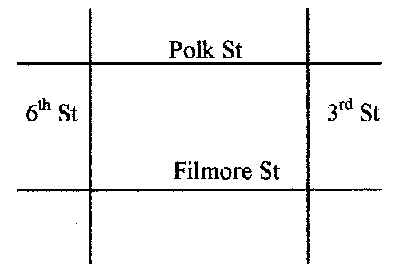
10. Draw below what you consider to be the boundaries of your neighborhood?
Example: N-Polk
E-3rd St.
S-Filmore St.
W-6th St.
11. How involved are you with the City affairs?
a. Very involved
b. Somewhat involved
c. Fairly involved
d. Not involved
12. Would you be willing to participate in neighborhood planning efforts to help direct the future of your neighborhood? If so please indicate your name, address, and phone number on the attached note card.
Please return to: City of Harlingen Planning Dept., 502 E. Tyler, Harlingen, TX 78550
Planning & Development | Harlingen's Vision 2020 Comprehensive Plan | Table of Contents
(c) copyright 2004, City of Harlingen